The Bull Soda Rise Gummies proprietary blend is a 200 mg mix of three plant extracts in each cherry-cola gummy: Panax ginseng, maca root and rhodiola, each marked 20:1. The seller publishes the blend's total weight but not how those 200 mg divide between the three. This page explains what the label order lets you work out, what it does not, and why that gap matters when you read about these herbs.
What is in the Bull Soda Rise Gummies proprietary blend?
The blend holds three botanical extracts that together weigh 200 mg per gummy. According to the Supplement Facts the seller's information page publishes, they are Panax ginseng extract (20:1), maca root extract (20:1) and rhodiola extract (20:1), listed in that order.
The same page marks the blend's Daily Value as not established, which is normal for herbs: there is no official daily target for ginseng or maca. The seller's page also says its figures should be checked against the physical label, so confirm on your bottle before relying on anything here. We have no photo of the back panel, only the front.
| Blend line (seller's panel) | Ratio printed | Amount disclosed |
|---|---|---|
| Panax ginseng extract | 20:1 | not stated |
| Maca root extract | 20:1 | not stated |
| Rhodiola extract | 20:1 | not stated |
| Blend total | 200 mg |
The other six actives (niacin, vitamin B6, zinc, L-carnitine, L-citrulline and grape seed extract) are listed with their own amounts outside the blend. You can see them all on our ingredients overview and the full Supplement Facts breakdown.
What does “proprietary blend” mean on a supplement label?
A proprietary blend is a group of ingredients that a maker lists under one combined weight instead of giving each one its own amount. Federal labeling rules allow this, as long as the blend ingredients are listed in descending order of predominance by weight and the stated amount equals the total weight of those ingredients.1
So the label tells you two firm things: which ingredient weighs most, and what the whole group weighs. It does not tell you any single ingredient's amount. Makers often say this protects a recipe; for a shopper, it means less information to compare.
- You learn the names of the blend ingredients.
- You learn their order, heaviest first.
- You learn the combined weight (here, 200 mg).
- You do not learn the weight of any one of them.
How much ginseng, maca and rhodiola could the blend contain?
The label order sets limits, not amounts: Panax ginseng extract must be at least about 67 mg and under 200 mg, maca root extract can be no more than 100 mg, and rhodiola extract can be no more than about 67 mg. These figures come from simple arithmetic on the order rule,1 and the true split is not disclosed.
Here is how the math works. Ginseng is listed first, so it weighs at least as much as each of the others. If all three were equal, each would be about 67 mg, which is the least ginseng could be. Maca is second, so it cannot weigh more than ginseng; the most it could be is half the blend, 100 mg, with ginseng also at 100 mg. Rhodiola is last, so it cannot exceed an equal third.
| Ingredient | Lowest possible | Highest possible |
|---|---|---|
| Panax ginseng extract | about 67 mg | just under 200 mg |
| Maca root extract | close to 0 mg | 100 mg |
| Rhodiola extract | close to 0 mg | about 67 mg |
Every row is a limit we worked out from label order. None of them is a real amount, and the maker may use any split that stays inside these lines.
Can I test possible splits of the 200 mg blend?
Yes: the blend splitter below lets you slide through splits that respect the label order and see where the limits fall. It keeps ginseng at or above maca and maca at or above rhodiola, and it always reminds you that the real split is not published.
Use it to get a feel for how wide the range is. A split of 180, 15 and 5 mg is just as legal as 70, 67 and 63 mg, and the label looks the same either way.
Blend splitter
The 200 mg blend lists Panax ginseng, then maca, then rhodiola. Label order means each is at least as heavy as the next. Move the sliders to try splits that follow that rule. The real split is not disclosed; these are possibilities, not amounts.
Scale: 0 to 200 mg. Limits from label order: ginseng at least about 67 mg, maca no more than 100 mg, rhodiola no more than about 67 mg.
What does 20:1 mean on the Bull Soda Rise Gummies blend?
A 20:1 ratio is a concentration figure the maker states: it usually means about 20 parts of raw plant were used to make 1 part of extract. We cannot verify it, because no testing data or method has been published for these gummies.
Ratios like this are not standardized in a way that makes two products easy to compare. One 20:1 extract can differ from another in the plant part used, the solvent, and how much of any marker compound remains. A ratio also says nothing about how much of the extract ended up in each gummy, which is the number the blend hides.
So read 20:1 as the maker's description of its raw material, not as an amount you can multiply into a "raw herb equivalent" and compare with research.
Why does the undisclosed split matter for research doses?
It matters because research on these herbs is reported in specific doses and forms, and without each amount you cannot tell how a gummy compares. Any study you read is about the ingredient, often at other doses and in other preparations, never about Bull Soda Rise Gummies.
For Asian (Panax) ginseng, the National Center for Complementary and Integrative Health says the evidence is limited and most trials were small and lasted under three months.2 For rhodiola, the same agency says evidence is not strong enough to say it helps with any condition, and most studies were of low to moderate quality.3 For maca, Memorial Sloan Kettering notes that evidence is limited and comes from a few small human trials.4
Put together, that means two unknowns stack up: the herbs themselves have thin evidence, and the gummy does not say how much of each it contains. We do not know of any published study of this finished product. Our individual pages go deeper on Panax ginseng, maca root and rhodiola.
What safety notes apply to the blend's three herbs?
Each herb has its own cautions in official summaries, and they apply whatever the split turns out to be. Bring them to your pharmacist if you take medicines or manage a health condition.
- Panax ginseng: short-term use up to six months appears safe for most people; insomnia is the most common side effect; it may lower blood sugar, interfere with blood clotting, worsen autoimmune disorders and interact with medicines; it may be unsafe in pregnancy and is not advised when breastfeeding or for children.2
- Rhodiola: possibly safe for up to 12 weeks; reported effects include dizziness, headache, trouble sleeping, dry mouth or more saliva; an interaction with losartan, a blood pressure medicine, has been reported; little is known about pregnancy and breastfeeding.3
- Maca: reported effects include menstrual changes, moodiness, cramps, stomach irritation and insomnia; it may interfere with testosterone lab tests; people with hormone-sensitive cancers should talk to their provider; safety in pregnancy and breastfeeding is uncertain.4
Because ginseng is the heaviest blend ingredient by rule, its cautions deserve the most attention. Our side effects and medications pages pull these together with the vitamins and amino acids.
Does the front label say anything about the blend?
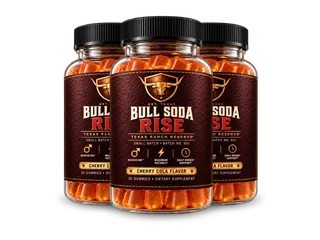
No: the front label we photographed names no herbs at all. It prints the brand, “TEXAS RANCH RESERVE”, “SMALL BATCH • BATCH NO. 001”, the cherry cola plate, “30 GUMMIES • DIETARY SUPPLEMENT” and three icons with asterisked capitals.
Those capitals read “MASCULINE*”, “MAXIMUM POTENCY*” and “DAILY ENERGY SUPPORT*”. The asterisk on wording like this normally points to the standard notice that the FDA has not evaluated the statement and that the product is not intended to diagnose, treat, cure or prevent any disease.5 The word “POTENCY” on the front is marketing language, not a measure of how much ginseng, maca or rhodiola is inside. Our label page walks through each printed line.
How do I check the blend on my own bottle?
Turn the bottle and read the Supplement Facts panel: it should list the same three extracts in the same order with a 200 mg total. If the order, the ratio or the total differs from what the seller publishes, the bottle in your hand is what counts.
Some pages online describe a different formula; the bottle's panel decides. A quick check takes a minute:
- Find the line that starts “Proprietary Blend” and read its total weight.
- Note the order of the three herbs under it.
- Look for the 20:1 ratio beside each extract.
- Check for a disclaimer tied to the asterisk.
- Note the lot and best-before print on the base, if your bottle shows it.
If anything looks wrong, our bottle check guide covers what to compare and who to contact.
Where can I buy Bull Soda Rise Gummies with this blend?
The seller sells the gummies through its own checkout, in packs of 2, 3 or 6 bottles. When we checked on November 25, 2026, the checkout showed totals of $158 for 2 bottles, $207 for 3 bottles and $294 for 6 bottles. That works out to about $2.63, $2.30 and $1.63 a day at one gummy daily; confirm at the live checkout, since the seller sets and can change prices.
The 6-bottle pack has the lowest price per bottle. The checkout uses countdown and stock-count banners; ignore them and read the total. When you are ready, you can see today's checkout total, or compare packs first on our pricing page.
Questions people ask
Does the Bull Soda Rise Gummies proprietary blend list each herb's amount?
No. The seller's panel gives only the 200 mg total for Panax ginseng, maca and rhodiola extracts, so the amount of each one is not disclosed.
Is ginseng the largest part of the Bull Soda Rise Gummies blend?
By label order, yes: Panax ginseng extract is listed first, so it must weigh at least as much as maca and rhodiola. That puts it at about 67 mg or more, though the exact figure is not published.
Can I compare the Bull Soda Rise Gummies blend with ginseng studies?
Not reliably. Studies use specific doses and preparations, and the gummy does not state its ginseng amount, so any comparison is a guess. Research on the herb is not research on the gummy.
Is the 20:1 ratio in Bull Soda Rise Gummies independently verified?
Not that we know of. The ratio is the maker's own description of its extracts, and no testing results have been published for us to check.
Should I ask a pharmacist before taking the Bull Soda Rise Gummies herbal blend?
It is a sensible step if you take medicines or have a health condition. Ginseng, rhodiola and maca each have interaction or safety notes, including blood sugar, blood clotting, blood pressure medicine and hormone-sensitive conditions.
Sources for this page
- eCFR: 21 CFR 101.36, Nutrition labeling of dietary supplements. www.ecfr.gov
- NCCIH: Asian Ginseng, Usefulness and Safety. www.nccih.nih.gov
- NCCIH: Rhodiola, Usefulness and Safety. www.nccih.nih.gov
- Memorial Sloan Kettering Cancer Center: About Herbs, Maca. www.mskcc.org
- FDA: Structure/Function Claims. www.fda.gov
These statements have not been evaluated by the Food and Drug Administration. This product is not intended to diagnose, treat, cure, or prevent any disease. Safety: Bull Soda Rise Gummies are a dietary supplement, not a medicine. Adults 18+ only; follow the serving printed on your bottle (the seller lists one gummy once daily). The panel lists niacin, vitamin B6, zinc and Panax ginseng, maca and rhodiola extracts, which can matter if you take diabetes, blood pressure, blood-thinning, seizure or antibiotic medicines, are pregnant or nursing, or have surgery planned. Ask your doctor or pharmacist first, and never stop prescribed treatment. Keep the gummies away from children. This site is an independently run information site about Bull Soda Rise Gummies; the owner states it is a USA Authorized Bull Soda Rise Retailer. It is not the maker. We may earn money when you order through links marked as sponsored. Prices, shipping and refund terms are set by the seller; we show them as we found them, so confirm at the live checkout.